Prohibiton Era History
Prohibition Era Photos
Prohibition of alcohol, often referred to simply as prohibition, also known as Noble Experiment, refers to a sumptuary law which prohibits alcohol. Typically, the manufacture, transportation, import, export, and sale of alcoholic beverages is restricted or illegal. The term can also apply to the periods in the histories of the countries during which the prohibition of alcohol was enforced. Use of the term as applicable to a historical period is typically applied to countries of European culture. In the Muslim World, consumption of alcoholic beverages is forbidden according to Islamic Law — though the strictness by which this prohibition was and is enforced varies considerably between various Islamic countries and various periods in their history.
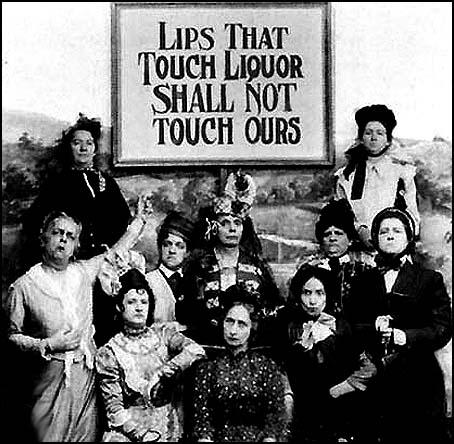
In the early twentieth century, much of the impetus for the prohibition movement in the Nordic countries and North America came from Protestant wariness of alcohol; the prohibition era. Prohibition era photos reveals much about that lifestyle during the 1920s.
The Nordic countries, with the exception of Denmark, have had a long temperance tradition. Prohibition was enforced in Iceland from 1915 to 1922 (with beer prohibited until 1989), in Norway from 1916 to 1927 and in Finland between 1919 and 1932. Sweden enforced a rationing system (Brattsystemet or "motboken") between 1914 and 1955; a referendum in 1922 rejected total prohibition. Alcohol was still prohibited in the Faroe Islands until 1992. Nordic countries today, with the exception of Denmark, strictly control the sale of alcohol. There are government monopolies in place for selling liquors, wine and stronger beers to consumers, in Norway (Vinmonopolet), Sweden (Systembolaget), Iceland (Vínbúðin) and Finland (Alko). Corporations, like bars and restaurants, may import alcoholic beverages directly or through other companies. The temperance movement in Scandinavia (parts of which are affiliated with the International Organization of Good Templars), which advocates strict government regulations concerning the consumption of alcohol, have seen a decline in membership numbers and activity during the past years but are now on the rise again, in example Swedish IOGT-NTO having a net gain of 12,500 members in 2005.
The prohibition era.
The Anti Saloon League, founded in 1893 in Oberlin, Ohio began life as a state organization. Its first offices were in Columbus, Ohio; in 1909, the League moved to nearby Westerville, Ohio where it also operated the American Issue Publishing Company. After 1895, however, the League became a powerful national organization. The League was a non-partisan organization that focused on the single issue of prohibition. The League had branches across the United States to work with churches in marshalling resources for the prohibition fight. In 1913, in a 20th anniversary convention held in Columbus, Ohio, the League announced its campaign to achieve national prohibition through a constitutional amendment.
Allied with other temperance forces, especially the Woman's Christian Temperance Union, the League in 1916 oversaw the election of the two-thirds majorities necessary in both houses of Congress to initiate what became the Eighteenth Amendment to the Constitution of the United States.
These prohibition era photos show the seriousness of the prohibition movement in the 1920's.
Against Drunk Driving
Yard Signs
Anti Gambling
The Ten Commandments
https://noalcohol.us/noalcohol/no_alcohol.phtml
Return to Home Page
Prohibition
Links
Links
Scripture Alcohol
Advertising
Resources
Advertising
Campaign Yard Signs
Prohibition of Alcohol
Prohibition Era History of the 1920s
 |
| Prohibition Era History in America |
After several years, the prohibition era became a failure in North America and elsewhere,
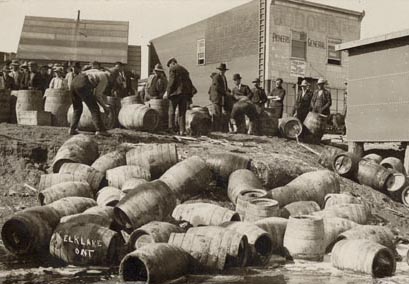
as bootlegging (rum-running) became widespread and organized crime took control of the distribution of alcohol. Distilleries and breweries in Canada, Mexico and the Caribbean flourished as their products were either consumed by visiting Americans or illegally exported to the United States. Chicago became notorious as a haven for prohibition dodgers during the time known as the Roaring Twenties. Prohibition generally came to an end in the late 1920s or early 1930s in most of North America and Europe,
although a few locations continued the prohibition history for many more years.
The during the Prohibition Era History of 1920s the sale of alcohol was illegal, but alcoholic drinks were still widely available. People also kept private bars to serve their guests. Large quantities of alcohol were smuggled in from Canada, overland, by sea along both ocean coasts, and via the Great Lakes. The government cracked down on alcohol consumption on land within the U.S. It was a different story on the water where vessels outside the 3 mile limit were exempt. Legal and illegal home brewing was popular during Prohibition. "Malt and hop" stores popped up across the country and some former breweries turned to selling malt extract syrup,
ostensibly for baking and beverage purposes.
History reflects that the Democrats, who changed from drys led by conservative
Democrats and Catholics to supporting repeal led by liberal politicians such as
La Guardia and Franklin Roosevelt. The Democrats emphasized that repeal would
generate enormous sums of much needed tax revenue, and weaken the base of organized crime.
The Repeal of Prohibition in the United States was accomplished with the passage of
the Twenty-first Amendment to the United States Constitution on December 5, 1933.
By its terms, states were allowed to set their own laws for the control of alcohol.
The organized Prohibition movement was dead nationwide, but survived for a while in a few southern and border states.
We at God's Word from the Scriptures thank you for visiting our site.
|